•  

Man weaves future for ethnic brocade craftsmanship in China's Hainan

STORY: Man weaves future for ethnic brocade craftsmanship in China's Hainan DATELINE: June 11, 2022 LENGTH: 00:01:06 LOCATION: HAIKOU, China CATEGORY: CULTURE SHOTLIST: 1. SOUNDBITE (English): HUANG YANGWEI, Craftsman STORYLINE: Huang Yangwei is a native of Maodao Township in Wuzhishan County, south China's Hainan Province. Born into a family of the Li ethnic minority, Huang was immersed in the Li culture as a kid, especially the Li ethnic brocade, which is famous for its bright, striking colors. The intangible cultural heritage of the Li brocade can trace back to over 3,000 years ago. In line with the Li tradition, the brocade weaving techniques were only "passed on to women, not to men." Huang did not know much about craftsmanship until he was in high school, when local authorities organized an event to introduce intangible cultural heritage into the school campus in 2016. After the event, Huang fell in love with the Li brocade and became the only man in his village who can weave the brocade. SOUNDB

  •  
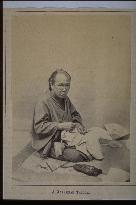
Tailor

Tailor

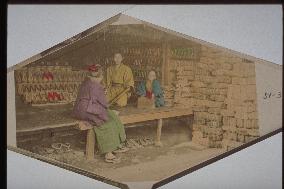
Carried on page 31 of the May 14, 1872 edition of The Far East. The man's face is pitted with small pox and is not at all handsome, but he is skilled in sewing. He is indispensable to the foreign women customers. His tools are rare, such as needles, scissors and a ruler.==Date:Early Meiji, Place:unknown, Photo:THE FAR EAST, (Credit:Nagasaki University Library/Kyodo News Images) [Cabinet Number17‐48‐0]

  •  
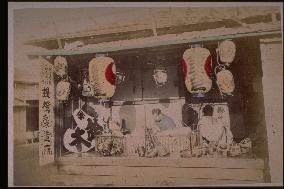
Lantern factory

Lantern factory

A man makes lanterns in his shop open to the road. Lanterns of various sizes hang from the ceiling, and folded lanterns of various sizes also hang from the counter screen surrounding the man. A large board with Lantern Manufacturer hangs at the corner of the shop.==Date:Middle Meiji, Place:unknown, Photo:unknown, (Credit:Nagasaki University Library/Kyodo News Images) [Cabinet Number15‐7‐0]

  •  
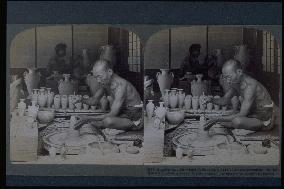
A wheel and a potter painting a picture

A wheel and a potter painting a picture

Potters work on vases at the Kinkozan Sobei Pottery Factory. The half-naked man in the foreground is shaping a vase on the wheel using a pallet, while the man in the back is painting a vase. This is the Awata Kiln, located at Sanjo-Awataguchi. Founded in 1633, it exported ceramic ornaments and utensils to North America and Europe as well as China and India. This may have been taken by the British photographer H. G. Ponting.==Date:1904, Place:Kyoto, Photo:Underwood, (Credit:Nagasaki University Library/Kyodo News Images) [Cabinet Number97‐31‐0]

  •  
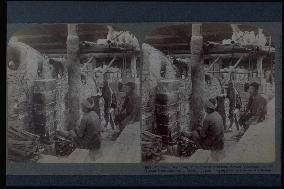
Workmen doing iron-pot work

Workmen doing iron-pot work

Potters tend the fire in a noborigama (climbing kiln) at the Kinkozan Sobei Kiln. Three men are checking the condition of the fire. The kiln is made from bricks and clay. It was located in Sanjo-Awataguchi and specialized in Awata style pottery. Founded in 1633, it exported ceramic ornaments and utensils to North America and Europe as well as China and India. This may have been taken by the British photographer H. G. Ponting.==Date:1904, Place:Kyoto, Photo:Underwood, (Credit:Nagasaki University Library/Kyodo News Images) [Cabinet Number97‐30‐0]

  •  
Shippoyaki (cloisonne ware) craftsmen

Shippoyaki (cloisonne ware) craftsmen

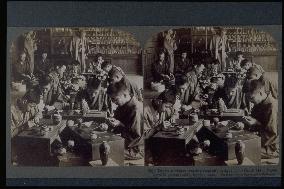
Young craftsmen work on vases in the cloisonne workshop of Namikawa Yasuyuki, using small tools at individual tables. Namikawa is observing their work from behind. Many small bottles of paint and chemicals are visible on the shelves behind the glass doors in the background. This may have been taken by H. G. Ponting in 1904.==Date:1904, Place:Kyoto, Photo:Underwood, (Credit:Nagasaki University Library/Kyodo News Images) [Cabinet Number97‐29‐0]

  •  
Making unbrellas

Making unbrellas

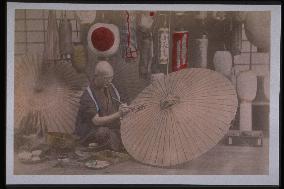
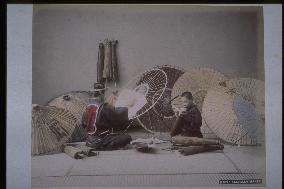
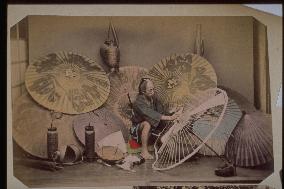
This is a scene in an umbrella workshop. The umbrellas visible here, called bangasa, were used daily by commoners during the Edo Period. The man is writing something on the finished umbrella. It was common practice to write the names of customers or shops on umbrellas.==Date:unknown, Place:unknown, Photo:unknown, (Credit:Nagasaki University Library/Kyodo News Images) [Cabinet Number96‐20‐0]

  •  
Making unbrellas

Making unbrellas

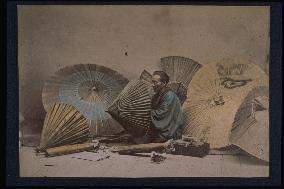
This is a scene in an umbrella workshop. The man seems to be repairing a bangasa, the umbrella popular among the common people during the Edo Period. He is checking to see if previous repair work was done properly.==Date:unknown, Place:unknown, Photo:unknown, (Credit:Nagasaki University Library/Kyodo News Images) [Cabinet Number96‐14‐0]

  •  
A geta clog craftsman

A geta clog craftsman

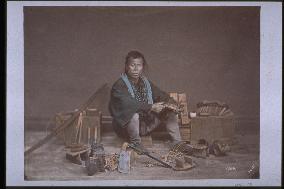
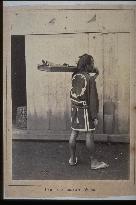
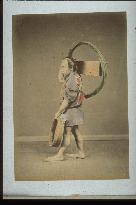
This craftsman walks around the city offering his services in repairing wooden geta clogs, supports for clogs, and thongs. He carries his tools, like a hatchet, plane, and chisels, in a tool box hanging from a balancing pole. His hair is combed in typical craftsman's style, and he wears a hanten coat, gaiters and straw sandals. This is a studio photograph.==Date:unknown, Place:unknown, Photo:Usui Shuzaburo, (Credit:Nagasaki University Library/Kyodo News Images) [Cabinet Number94‐38‐0]

  •  
Making unbrellas

Making unbrellas

This is scene in an umbrella workshop. The umbrellas visible here, called bangasa, were used daily by commoners during the Edo Period. The man is pasting sheets of fan-shaped paper called hiragami on the main frame. The boy on the right is applying shibu (persimmon tannin) to an umbrella.==Date:unknown, Place:unknown, Photo:unknown, (Credit:Nagasaki University Library/Kyodo News Images) [Cabinet Number88‐45‐0]

  •  
Carpenters

Carpenters

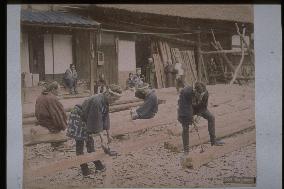
Carpenters carve pillars in preparation for the construction of a house. The man on the left is using a carpenter's ink pad. The man on the right is using a hand axe. The man in the back is chiseling lumber.==Date:unknown, Place:unknown, Photo:unknown, (Credit:Nagasaki University Library/Kyodo News Images) [Cabinet Number84‐25‐0]

  •  
A barber's shop

A barber's shop

A customer smokes tobacco while having his hair arranged. The man on the right is having his beard shaved, holding a board to gather the cut hair. The tool boxes suggest that they are travelling barbers. A water pail is visible in front.==Date:unknown, Place:unknown, Photo:R. Stillfried, (Credit:Nagasaki University Library/Kyodo News Images) [Cabinet Number77‐37‐0]

  •  
Farmers wearing straw raincoats and caps

Farmers wearing straw raincoats and caps

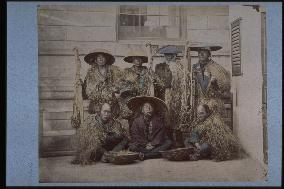
The men wear bamboo hats and hold straw baskets. They seem to be construction workers. These baskets were used by two people to carry stones and other heavy loads. The man wearing a chest coat under his raincoat may be a work union member.==Date:unknown, Place:unknown, Photo:R. Stillfried, (Credit:Nagasaki University Library/Kyodo News Images) [Cabinet Number76‐43‐0]

  •  
A leader and his pupil

A leader and his pupil

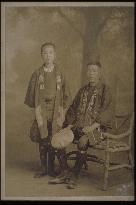
A master carpenter from Yamaguchi-gumi poses with his apprentice. The resemblance suggests that they are father and son. If this is correct, their family name could be Kumada. The master carpenter is holding a deerstalker hat and wearing leather shoes. They may have dressed up for the photograph. This photograph was taken at a studio with a backdrop, not on location, probably around 1897.==Date:1924, Place:Tokyo, Photo:unknown, (Credit:Nagasaki University Library/Kyodo News Images) [Cabinet Number72‐31‐0]

  •  
A cargo carrier

A cargo carrier

The life of commoners was free and open as shown in this photograph. Men were almost naked on hot days, wearing only head towels, loincloths and straw sandals. These men are most likely gardeners.==Date:unknown, Place:unknown, Photo:unknown, (Credit:Nagasaki University Library/Kyodo News Images) [Cabinet Number69‐47‐0]

  •  
Men at hairdressing

Men at hairdressing

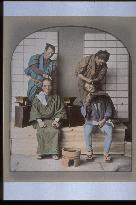
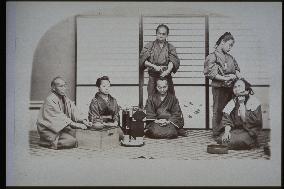
Hairdressers and their customers are depicted in a carpeted salon. The two people on the left are sitting next to a brazier with an iron pot on it. Combs and other hairdressing tools are visible in the box in the centre. The man on the far right is having facial hair shaved and his sakayaki shaped. A white cloth is placed on the shoulders to protect the kimono. Taken by Ogawa Kazumasa.==Date:unknown, Place:Kyoto, Photo:Ogawa Kazumasa, (Credit:Nagasaki University Library/Kyodo News Images) [Cabinet Number67‐40‐0]

  •  
Making unbrellas

Making unbrellas

This is scene in an umbrella workshop. The umbrellas visible here, called bangasa, were used daily by commoners during the Edo Period. This is the stage at which the nokigami, is attached to the edge of the spokes to reinforce the outer edge of the umbrella.==Date:unknown, Place:unknown, Photo:unknown, (Credit:Nagasaki University Library/Kyodo News Images) [Cabinet Number57‐1‐2]

  •  
Farmers wearing straw raincoats and caps

Farmers wearing straw raincoats and caps

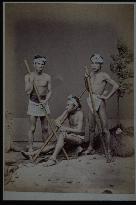
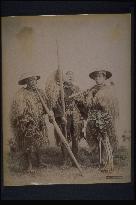
Three men wear bamboo hats and hold straw baskets. They seem to be construction workers. These baskets were used by two people to carry stones and other heavy loads. The man wearing a chest coat under his raincoat may be a work union member. The man on the right has long radishes hanging from his waist.==Date:unknown, Place:unknown, Photo:unknown, (Credit:Nagasaki University Library/Kyodo News Images) [Cabinet Number51‐105‐0]

  •  
A carpenter

A carpenter

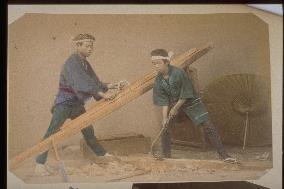
Carpenters work with planes. One of them is wearing a headband. The man in front is shaving the wood with a hand axe. It is hard to explain what an umbrella is doing in this setting.==Date:unknown, Place:unknown, Photo:unknown, (Credit:Nagasaki University Library/Kyodo News Images) [Cabinet Number51‐16‐0]

  •  
Workmen at lunch

Workmen at lunch

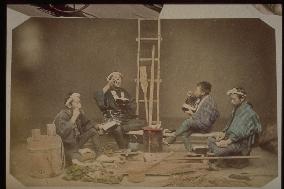
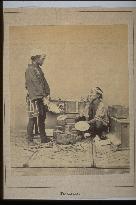
This is a scene of three men eating meals. The man on the right has a gloomy look. Tea cups are placed on a tray on top of a can that is probably used to make a fire. The ship-shaped container is used to mix rice straw with soil. A water pail is shown along with a trowel and ladle.==Date:unknown, Place:unknown, Photo:unknown, (Credit:Nagasaki University Library/Kyodo News Images) [Cabinet Number51‐15‐0]

  •  
Making unbrellas

Making unbrellas

This is scene in an umbrella workshop. The umbrellas visible here, called bangasa, were used daily by commoners during the Edo Period. The man is pasting a fan-shaped sheet of paper called hiragami to the main frame.==Date:unknown, Place:unknown, Photo:unknown, (Credit:Nagasaki University Library/Kyodo News Images) [Cabinet Number51‐11‐0]

  •  
A geta clog craftsman

A geta clog craftsman

A customer is choosing footwear in a geta (wooden clogs) shop, with the shop owner and his apprentice on the right. Many clogs, straw sandals, and thongs are displayed on the shelves inside the shop. On the right side of the shop is a pile of raw materials used to make clogs.==Date:unknown, Place:unknown, Photo:unknown, (Credit:Nagasaki University Library/Kyodo News Images) [Cabinet Number51‐3‐0]

  •  
Japanese lantern maker and umbrella maker

Japanese lantern maker and umbrella maker

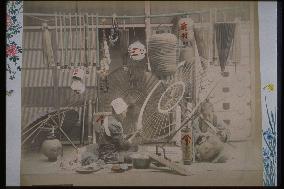
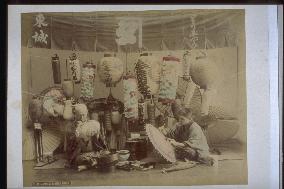
A shop selling both lanterns and umbrellas. They seem to be making and selling them. Many kinds of lanterns are hung. The name of the shop is Tojo. An old man writes on the lanterns, and a young craftsman colours the umbrella.==Date:unknown, Place:unknown, Photo:unknown, (Credit:Nagasaki University Library/Kyodo News Images) [Cabinet Number43‐6‐0]

  •  
Cherry trees at Ueno Park

Cherry trees at Ueno Park

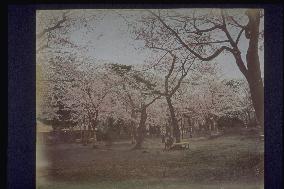
Ueno park is one of the parks built by the Meiji government. Shiba Park is also one of them, and both have a similar characteristic that the tomb place of the Shogun were opened to the public. The Azumaya can be seen to the left rear, and a craftsman-like man stands on the bench built by the trunk of the cherry tree in the center.==Date:unknown, Place:Tokyo, Photo:unknown, (Credit:Nagasaki University Library/Kyodo News Images) [Cabinet Number37‐64‐0]

  •  
Greeting man and woman

Greeting man and woman

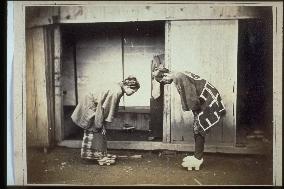
A wife dressed in everyday clothes and a craftsman in patchi (long underwear), happi and sandals exchange greetings in front of her house. The man has a top-knot, but this is obviouslya wig. (Dramatized photo)==Date:unknown, Place:unknown, Photo:unknown, (Credit:Nagasaki University Library/Kyodo News Images) [Cabinet Number18‐43‐0]

  •  
Tinman

Tinman

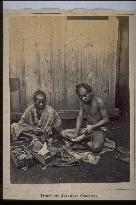
Carried on page 271 of the March 24, 1873 edition of The Far East. Entitled Craftsmen in tinplate . There is no article to explain the picture. Two tinplate craftsmen wearing top knots make containers with tools.==Date:Early Meiji, Place:unknown, Photo:THE FAR EAST, (Credit:Nagasaki University Library/Kyodo News Images) [Cabinet Number17‐58‐0]

  •  
A carpenter

A carpenter

Carried on page 115 of the September 3, 1872 edition of The Far East. The title says a carpenter going off to work , but there is no explanation in the article. A carpenter with a top knot and wearing a happi carries a tool box with a plane and saw on his back.==Date:First year of Meiji, Place:unknown, Photo:unknown, (Credit:Nagasaki University Library/Kyodo News Images) [Cabinet Number17‐52‐0]

  •  
Repairing shoes

Repairing shoes

Carried on page 43 of the May 30, 1872 edition of The Far East. Entitled Traveling shoe repair man in Japan . The explanation says that the men in the photo are outcasts, that they engage in the leather industry and as criminal executioners, and that there is no reason to discriminate against them apart from their professions.==Date:Early Meiji, Place:unknown, Photo:THE FAR EAST, (Credit:Nagasaki University Library/Kyodo News Images) [Cabinet Number17‐46‐0]

  •  
Sawyers

Sawyers

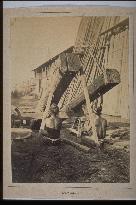
Carried on page 151 of the October 19, 1872 edition of The Far East. The explanation says that the Japanese do things the other way compared to Westerners. The direction of the teeth of the saw and the way it is used show that. They worked slowly but constantly and the work load was large.==Date:Early Meiji, Place:unknown, Photo:THE FAR EAST, (Credit:Nagasaki University Library/Kyodo News Images) [Cabinet Number17‐45‐0]

  •  
Tub mender

Tub mender

Traditional pails with boards aligned in a circle and held together with hoops was invented in the Muromachi era. Pine was mainly used for the boards, and the okeya (pail shops) were usually operated by craftsmen who were also vendors. Some craftsmen specialized in putting on the hoops, like the man in this photo.==Date:unknown, Place:unknown, Photo:unknown, (Credit:Nagasaki University Library/Kyodo News Images) [Cabinet Number13‐6‐0]

  • Main
  • Top
  • Editorial
  • Creative
  • About Us
  • About ILG
  • Terms of use
  • Company
  • BEHIND
  • Price List
  • Single Plan
  • Monthly Plan
  • Services
  • Shooting
  • Rights Clearance
  • Support
  • FAQ
  • How To Buy
  • Contact Us
  • Become a Partner

© KYODO NEWS IMAGES INC

All Rights Reserved.

  • Editorial
  • Olympics
  • News
  • Sports
  • Japan
  • Tech
  • Royal
  • Disaster
  • NorthKorea
  • Old Japan
  • SNS
  • Creative
  • Food
  • Japan
  • Landscape
  • Animal
  • Popular
  • #Ukraine
  • #Russia
  • #coronavirus
  • #N. Korea
  • #China
  • #Thailand
  • #Ukraine
  • #Russia
  • #coronavirus
  • #N. Korea
  • #China
  • #Thailand
  • Food
  • Japan
  • Landscape
  • Animal
  • Olympics
  • News
  • Sports
  • Japan
  • Tech
  • Royal
  • Disaster
  • NorthKorea
  • Old Japan
  • SNS